Bedding · Materials & Care
How to Assess an Organic Mattress: Materials, Support, and Durability
The word “organic” can sound like a complete answer. On a mattress, it is only a starting point. A thoughtful assessment looks beneath the label to the materials in each layer, the way those layers are assembled, the support they provide, and the evidence behind environmental claims.
Published November 2, 2026
A mattress is a quiet composition of materials: a cover against the skin, comfort layers that ease pressure, and a core that carries the body through the night. In an organic mattress, those elements may include natural latex, cotton, wool, or other fibers, but the presence of a single natural component does not describe the whole. What matters is how much of each material is used, where it appears, how it is processed, and whether the finished mattress suits the person sleeping on it.
That distinction is useful because terms such as natural, green, and eco-friendly are often used broadly. “Organic” can have a more specific meaning when it refers to a verified material or production standard, yet the claim may apply to only one part of a mattress. A clear assessment therefore begins with the specification—not the adjective—and follows the details from cover to core.
Start with the complete materials list
Ask for a layer-by-layer description. A useful specification identifies the cover fabric, quilting, comfort layers, support core, adhesives or bonding methods where relevant, and any fire barrier. It should name materials with enough precision to distinguish, for example, natural latex from a blend, or wool batting from a generic fiber filling. If a description mentions “natural materials” without saying what they are or where they sit, it leaves important questions unanswered.
The order and depth of layers influence feel as well as composition. A thin wool layer at the surface may affect temperature and initial softness, while a substantial latex comfort layer can shape pressure relief and responsiveness. The support core determines much of the mattress’s foundational behavior. Two mattresses with similar lists of materials can feel quite different when the layers vary in thickness, density, firmness, and arrangement.
- Cover and quilting: Identify the textile and any filling beneath it. Consider how the cover affects airflow, texture, and care.
- Comfort layers: Look for the material, thickness, and position of each layer. These layers shape cushioning and pressure distribution.
- Support system: Determine whether the core is latex, springs, or another construction, and request details about its design.
- Assembly: Ask how the mattress is held together and whether the construction relies on adhesives, stitching, tufting, or other methods.
- Fire protection: Find out what barrier or treatment is used and request the manufacturer’s documentation.
Transparency is not a luxury detail; it is the basis for comparison. A maker that can explain each layer gives readers a better chance of evaluating comfort, material claims, and maintenance needs. When information is incomplete, treat the gap as a reason to ask questions rather than assume the most favorable interpretation.
Understand natural latex—and its limits
Natural latex is made from rubber tree sap that is processed into a resilient foam. It is valued for its buoyant, responsive feel: instead of sinking slowly in the way some foams do, it tends to compress under pressure and spring back. In mattress construction, latex can serve as a comfort layer, a support layer, or both, depending on its thickness and firmness.
“Natural latex” does not, by itself, tell the whole story. Ask whether the layer is made entirely from natural rubber or includes synthetic latex, and whether the stated composition refers to the foam itself or to the finished mattress. The manufacturing method can also affect the feel and structure. Dunlop and Talalay are commonly used process names; neither should be treated as a simple guarantee of superior quality. The overall formulation, density, firmness, and construction are more informative than a process label alone.
Latex is often described as durable and elastic, but performance depends on the quality and specification of the material, the support beneath it, and the way the mattress is used. Ask for the latex layer’s thickness and firmness, and look for a technical description that helps explain how it contributes to the whole design. If the manufacturer uses a certification claim, check which material it covers and what the certification verifies.
For people with a known latex allergy, the word “natural” is not a substitute for individualized medical guidance. Mattress construction and exposure circumstances differ, and product descriptions do not determine personal safety. Consult a qualified health professional if an allergy is a concern, and ask the manufacturer for full material and cover details.
Read certifications with precision
A certification is most useful when you know what has been assessed. Some standards apply to the agricultural origin of a fiber; others may address chemical emissions, processing, or product testing. A label on one component should not automatically be read as certification of every layer in the mattress. Check the certificate’s scope, the specific material or product named, the issuing organization, and whether the documentation is current.
Look for verifiable details rather than a collection of reassuring symbols. A reliable claim should be traceable to a named standard or certifying body and supported by a certificate or searchable listing where applicable. Ask whether the certification covers the finished mattress, the latex, the textile, or only a particular ingredient. This careful reading avoids confusing a material-level credential with a blanket endorsement of the complete product.
Certifications can inform a decision, but they are not a substitute for comfort testing, construction details, or clear care guidance. Nor does a certification alone establish that a mattress is the right choice for every sleeper. Treat it as one evidence point within a broader assessment: meaningful, but not all-encompassing.
Match mattress support to your sleep position
Support is personal. It describes how a mattress holds the body, not simply whether its surface feels hard or soft. A mattress that feels welcoming in a showroom may not maintain comfortable alignment through a full night, and firmness labels are not standardized across every maker. The more useful question is whether the mattress lets the body settle without pronounced pressure or an unsupported feeling.
Sleep position offers a practical starting point. Side sleepers often need enough cushioning around the shoulders and hips to reduce concentrated pressure, while still receiving support through the waist and torso. Back sleepers may prefer a more even balance between surface comfort and a stable central support. Stomach sleepers frequently look for a surface that limits excessive sinking through the hips. These are general considerations, not fixed rules: body shape, personal preference, and health needs all influence what feels comfortable.
If two people share a bed, their needs may differ. Compare the mattress’s motion response, usable surface, and edge behavior, as well as its firmness. A design that offers strong contouring may feel different from one with a buoyant, more responsive surface. Whenever possible, use a trial period to assess the mattress in the setting where it will actually be used, and read the terms before relying on a return policy.
- Notice whether your shoulders, hips, and lower back feel comfortably supported in your usual position.
- Pay attention to pressure, stiffness, or a sense of sinking that persists after settling in.
- Consider whether movement from a partner travels across the bed or feels contained.
- Test the mattress with the bed frame or foundation you intend to use; compatibility can affect performance.
- Allow time for a considered trial, while following the manufacturer’s setup and care instructions.
An organic mattress is not automatically supportive because it contains latex, nor is a firm mattress necessarily more supportive than a softer one. Support emerges from the combined structure: materials, layer thickness, core design, and the sleeper’s body. If a product description offers only a firmness adjective and no explanation of construction, it may be difficult to predict how the bed will behave.
Look beyond the surface feel
Initial comfort is only one part of the experience. Temperature, moisture, and movement can influence whether a mattress feels pleasant over time. Wool and some plant-based fibers are often used in upholstery for their characteristic moisture management and insulating qualities, while latex’s open structure and the overall design may influence airflow. Still, no material performs in isolation: the cover, quilting, room climate, sheets, and sleeper all contribute.
If you tend to sleep warm, ask how the mattress layers are arranged and whether its cover or quilting may retain warmth. Avoid assuming that a material name guarantees a cooling effect. A breathable cover cannot necessarily offset a dense comfort layer, and a mattress advertised as temperature-regulating does not control the room itself. Think of the bed as part of a sleep environment, alongside bedding, ventilation, and seasonal adjustments.
Also consider how the mattress responds when you change position. Some sleepers appreciate a gentle contour; others prefer a surface that makes movement feel easy. Natural latex is typically known for resilience, but the feel varies with formulation and design. A hands-on trial, clear construction information, and a realistic understanding of your preferences are more useful than a single broad claim about “comfort.”
Assess durability as a construction question
Durability is not determined by price, weight, or the word “organic.” It depends on the resilience and quality of the materials, how securely layers are assembled, how evenly the mattress carries load, and how it is cared for. Ask what the manufacturer expects from the design, but be wary of precise lifespan promises that are not explained by evidence or warranty terms.
Construction features can offer clues. A stable core, well-anchored upholstery, and thoughtful edge support may help a mattress keep its shape during regular use. In some traditional builds, tufting or stitching is used to secure layers and limit migration. These methods are not a universal measure of quality, and their presence alone does not prove long life; they are details to understand alongside materials and workmanship.
The warranty deserves careful reading. Distinguish a defect warranty from a comfort guarantee, and note what counts as a covered indentation or failure. Check its duration, exclusions, required foundation, and whether the claim process is clearly described. A longer warranty is not a promise that a mattress will feel unchanged for that entire period. It is a set of conditions governing specified faults.
Ask whether the mattress can be rotated, whether it is designed to be flipped, and whether either action is prohibited. Not every construction is two-sided or symmetrical. Follow the care guide rather than applying a familiar routine from another bed. A suitable protector can help shield the sleep surface from spills and body oils; choose one that fits properly and does not significantly alter the feel you are trying to assess.
Care, upkeep, and the surrounding bed
A mattress is a substantial textile-and-material assembly, not a washable household linen. Most should not be soaked or put through a washing machine. Before purchase, look for plain instructions on spot cleaning, ventilation, rotation, and stain prevention. If care information is vague, ask the manufacturer how to handle ordinary spills and what methods could damage the materials or affect the warranty.
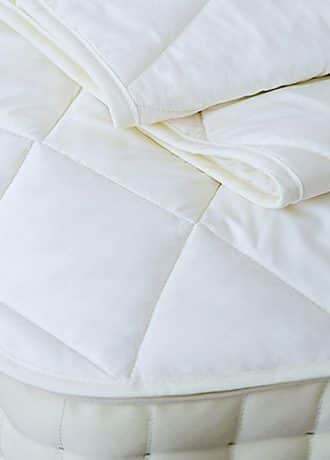
A protective layer can make routine care more practical. For example, the Vispring Lux Skirted Mattress Protector is described as a quilted cotton cover filled with British wool, with an elasticated skirt and care instructions for gentle washing. It is a mattress accessory rather than an organic mattress itself, but it illustrates how a washable barrier may help protect the surface. Check dimensions, pocket depth, and care requirements against the mattress you own before choosing any protector.
The foundation matters, too. A mattress used on an unsuitable base may not receive even support, and that can influence comfort and wear. Confirm the manufacturer’s requirements for slats, platform bases, or divans, including any spacing limits. Keep the bed area ventilated and follow instructions for unpacking and initial airing. These practical steps are less glamorous than material claims, yet they contribute to a better-informed ownership experience.
Distinguish meaningful claims from green language
Environmental language can be expansive. Words such as “clean,” “earth-conscious,” and “sustainable” may communicate an intention, but they do not identify a specific standard, a proportion of certified material, or a complete supply chain. Ask what the claim means in measurable terms. Which component is being described? What evidence supports the wording? Does the manufacturer explain the origin and processing of the materials?
A transparent maker should be able to discuss material composition without relying entirely on atmosphere. Look for named fibers, percentages where available, manufacturing details, relevant certificates, and a clear explanation of any blended materials. Where a claim is broader than the evidence provided, keep the distinction in view. Good research is not cynicism; it is a way to give each claim the weight it deserves.
Be especially alert to the difference between “organic” and “natural.” A fiber may be natural without being certified organic, and a mattress may contain organic cotton while using other materials with different credentials. That does not automatically make the mattress unsuitable. It does mean the product should be described accurately, so a reader can decide which material standards matter to them.
A considered comparison checklist
When comparing options, place specifications side by side rather than relying on brand language or memory. A short record of materials, support, certifications, and care can reveal meaningful differences that are easy to miss during a quick showroom visit or a series of online searches.
- Materials: Are all layers named, including covers, quilting, comfort materials, and support core?
- Composition: Are natural, organic, and blended components clearly distinguished?
- Latex details: Is the source and composition explained, with useful information about layer thickness and role?
- Support: Does the construction suit your sleep position, pressure needs, and comfort preferences?
- Certifications: Can you verify the standard and see which material or finished product it covers?
- Durability: Are construction, rotation guidance, warranty terms, and expected maintenance explained?
- Fit: Does it work with your foundation, bedroom conditions, and any partner’s needs?
- Care: Are cleaning instructions practical and specific, and can you protect the mattress appropriately?
The measure of a well-chosen mattress
The most persuasive organic mattress is not necessarily the one with the longest list of appealing fibers or the most polished environmental vocabulary. It is the one whose construction is understandable, whose claims are supported, and whose support feels right for the person using it. Natural latex may be a compelling part of that design, but it should be assessed in context: as one material within a carefully assembled whole.
Take time with the details. Read the specification, verify what certifications cover, test the mattress against your own comfort needs, and understand the warranty and care instructions before committing. A considered choice is less about buying an idealized label than finding a bed whose materials, performance, and practical demands align with your life. That is where the promise of an organic mattress becomes something more tangible: a transparent, supportive place to rest, designed with care from the inside out.